The rate and the threshold
Thailand's general VAT rate is 7% (the Revenue Department's English VAT page lists 7% as the general rate). Anyone who regularly supplies goods or services in Thailand with an annual turnover above 1.8 million baht is subject to VAT and must register — before starting the business, or within 30 days of income reaching the threshold.
Below 1.8 million baht a small business is exempt (Revenue Code s.81/1, with the small-business amount set by Royal Decree). Exempt does not mean you may charge VAT quietly: an exempt business does not charge VAT and does not issue tax invoices.
Registering by choice
A business below the threshold may still register. Section 81/3 gives an exempt business the right to apply for VAT registration. Reasons people do it: company customers who want a tax invoice, or input VAT on materials and tools they want to reclaim. The price is the monthly paperwork below, every month, whether or not you sold anything.
What registration obliges you to do
File a VAT return (Form VAT 30, ภ.พ.30) every month within 15 days of the following month, showing output VAT (what you charged) and input VAT (what you paid), and pay the difference — or carry forward or reclaim excess input VAT. Issue a tax invoice for each sale, with the contents the law prescribes (see the documents guide). Keep the copies.
What changes on your documents
Not registered: your invoice is headed ใบแจ้งหนี้, there is no VAT line, and your receipt is headed ใบเสร็จรับเงิน. You may print your tax ID if you wish.
Registered: your invoice becomes a tax invoice headed ใบกำกับภาษี with the VAT shown separately, your tax ID and the head-office/branch marking are mandatory, the customer's tax ID is added when the customer is VAT-registered, and the document is in Thai and baht unless the Director-General has approved otherwise. The receipt may be combined with the tax invoice.
What GlideQuote does
One switch in Settings › Tax & numbering — "VAT registered" — changes the headings on every new document, adds the VAT line at 7% (or the rate you set), prints your tax ID with the head-office suffix, and adds the client's tax ID when you have entered it. Leave the switch off and nothing on your documents claims VAT. VAT is a free feature; it is not part of the Pro plan.
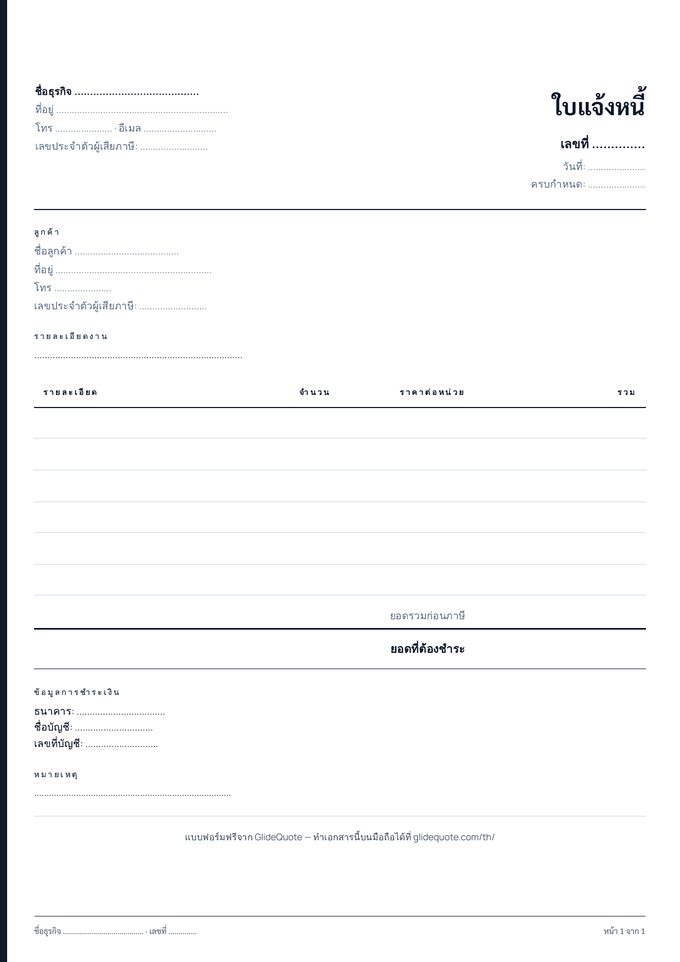 Invoice form (free PDF)A4, Thai, same design as the appAbout the invoice in Thailand →Example, what it must contain, how the app makes it
I'm under ฿1.8 million. Can I just add 7% to my invoices anyway?
How soon after I pass ฿1.8 million must I register?
How often is the VAT return?
Is 7% the permanent rate?
Ready to try it?Free plan, no card · Pro is free for the first month