The short version
A quotation (ใบเสนอราคา) says what the job will cost before you start. An invoice (ใบแจ้งหนี้) asks for payment. A tax invoice (ใบกำกับภาษี) is the VAT document — only a VAT-registered business may issue one. A receipt (ใบเสร็จรับเงิน) proves the customer paid.
If you are not VAT-registered you will use three of the four: quotation, invoice, receipt. If you are registered, the tax invoice replaces (or is combined with) the invoice and the receipt.
Quotation — no legal format
We could not find any provision of the Revenue Code that prescribes the content of a quotation, so this is an inference: it is a commercial document, not a tax one. Put on it what a customer needs to say yes — your name and tax ID, the customer, each item with quantity and price, the total, how long the price holds, and your payment terms. Thai customers will expect the date, and if they are a company they will often ask for your 13-digit tax ID even on the quotation.
Invoice — no legal format either
The same applies to an invoice from a business that is not VAT-registered: the Revenue Code does not prescribe its layout (again an inference from what is and isn't in the law). It is the request for payment. What matters is that the numbers match the quotation, the payment details are complete, and a receipt follows when the money arrives.
One rule does apply even to an unregistered business: do not head the document "ใบกำกับภาษี" / "tax invoice". That heading is reserved (next section).
Tax invoice — reserved for VAT-registered businesses, with a fixed list of contents
Only a VAT registrant may issue a tax invoice (Revenue Code s.86). An unregistered person who issues one is barred by s.86/13, becomes liable for the VAT shown, and faces a surcharge of twice the tax (s.89(6)) and, under s.90/4(3), 3 months to 7 years in prison plus a fine of 2,000–200,000 baht. This is the one document heading you must get right.
A full tax invoice must carry (s.86/4): the words ใบกำกับภาษี shown prominently; the seller's name, address and tax ID; the buyer's name and address; a running number (and book number if used); the goods or services with quantity and value; the VAT amount shown separately; and the date. Under Director-General Notice 199 it also carries the buyer's tax ID when the buyer is VAT-registered, and "สำนักงานใหญ่" (head office) or "สาขาที่ xxxxx" (branch) for both parties. It is written in Thai and in baht unless the Director-General approves otherwise, the copy is marked สำเนาใบกำกับภาษี, and it may be combined with an invoice or a receipt.
Receipt — required on payment, with its own list
A receipt is required for each payment above an amount the Director-General sets (the Code caps that threshold at 1,000 baht for VAT-registered businesses and 10,000 baht for others, s.105); in practice, issue one for every payment. If the customer pays in instalments, each instalment gets its own receipt (s.105). It must show (s.105 bis) the issuer's tax ID and name, a book and running number, the date, the amount and what it was for. Keep your copy for five years. A receipt written in a foreign language must also carry Thai.
What GlideQuote does
The app issues all four from your phone and chooses the heading for you: ใบเสนอราคา for a quotation; ใบแจ้งหนี้ for an invoice when you are not VAT-registered; ใบกำกับภาษี (or the combined ใบกำกับภาษี/ใบเสร็จรับเงิน) when you have turned on "VAT registered" in Settings; ใบเสร็จรับเงิน for a receipt. The quotation converts to an invoice with one tap, and "Set Paid" produces the receipt. Your tax ID prints when you are registered or when you switch it on, the client's tax ID prints when you have entered it, and Thai-registered sellers get the สำนักงานใหญ่ suffix.
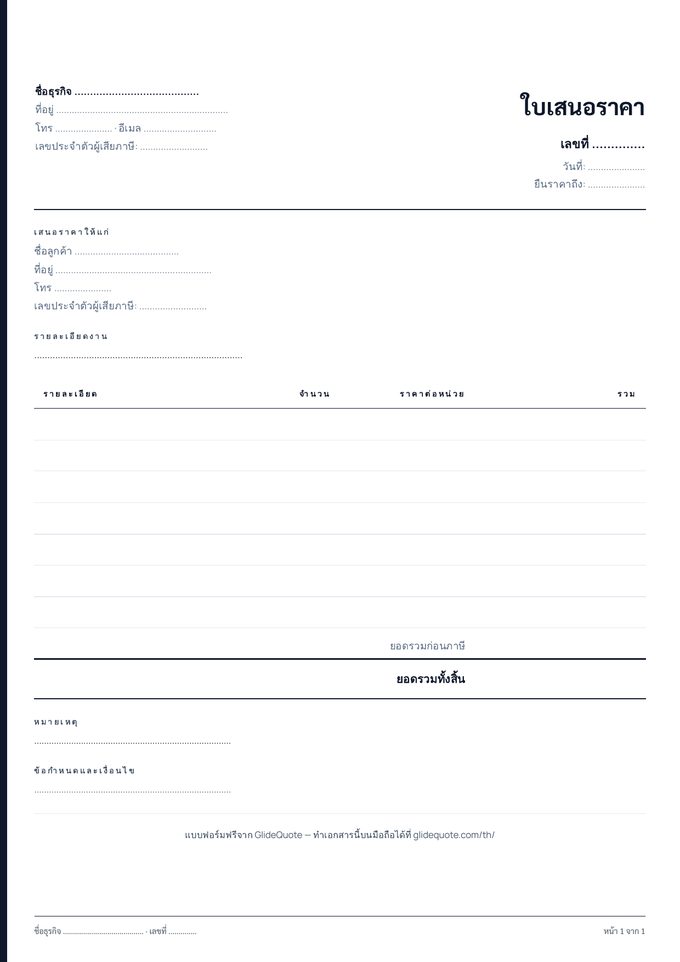 Quotation form (free PDF)A4, Thai, same design as the app
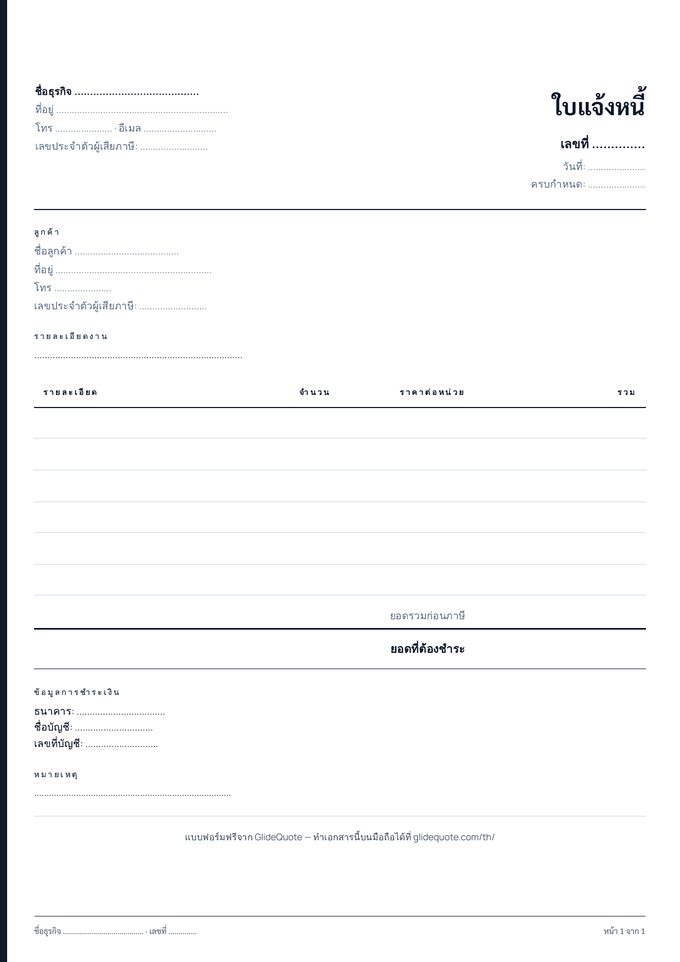 Invoice form (free PDF)A4, Thai, same design as the appAbout the quotation in Thailand →Example, what it must contain, how the app makes itAbout the invoice in Thailand →Example, what it must contain, how the app makes it
I'm not VAT-registered. Can I still write "tax invoice" on my invoice because the customer asked?
Does a quotation have to be in Thai?
Can one document be both the tax invoice and the receipt?
How long do I keep copies?
Ready to try it?Free plan, no card · Pro is free for the first month