1. Company or individual
The first fork. The Department of Business Development, quoted by the BOI's One Start One Stop centre, defines a Thai company as one where Thai nationals hold 51% or more of the shares, and a foreign company as one where foreigners hold more than 49%. A foreign company must check whether its activity sits in the lists of the Foreign Business Act B.E. 2542 (1999): List 1 activities are reserved for Thai companies; List 2 and List 3 activities need a Foreign Business License. An individual, by contrast, is a person trading under their own name and tax ID — the Revenue Department's tax-ID page treats a foreigner as an individual taxpayer who must register because they have no Thai ID number. Three set-ups, then — Thai company, foreign company, individual — and which one you end up in decides almost everything below.
2. The work permit
The BOI's March 2025 English note on the working of foreigners states the rule in five words: no employment without a valid work permit. The government's own eligibility page lists who may be granted one — the first listed is a foreigner holding a non-immigrant visa who applies under section 7. The documents the BOI centre lists for an application are employer documents: Form WP.1, an employment certification, the company's certificate of incorporation and shareholder list, its VAT registration. The Immigration Office's conditions for the business extension of stay add two numbers people quote constantly: paid-up capital of at least ฿2 million and a ratio of one foreign employee to four permanent Thai employees. Work permits and the three set-ups people invoice under →
3. Tax ID
Section 3 Undecim of the Revenue Code says a taxpayer or a payer of income shall obtain and use a taxpayer identification number. A Thai citizen uses the number on their ID card; a foreigner has no such number, so the Revenue Department lists "a foreigner" first among the individuals who must apply — within 60 days of first deriving assessable income, on Form L.P.10.1, at an area revenue office. A company applies within 60 days of incorporation on Form L.P.10.3. The number is 13 digits, and it is one of the particulars the Revenue Department requires on a tax invoice. How a foreigner gets a Thai tax ID →
4. A bank account
There is no single government rule for this; each bank sets its own documents. The government portal's own summary (which credits a travel company, so treat it as a secondary source) says most banks ask for a passport and a work permit, and that some branches accept a passport, a copy of your house registration and one supporting document instead. The practical point: the account that receives your invoices is the one whose name and number you print on them, so open it in the same name as the business — your own, or the company's.
5. VAT registration
The Revenue Department's English VAT page sets the line: anyone who regularly supplies goods or services in Thailand with an annual turnover above ฿1.8 million is a taxable person; a small entrepreneur below that is exempt. Registration is on Form VAT 01 within 30 days of reaching the threshold; the return is Form VAT 30 every month. The rate is 7%. The page lists what a tax invoice must carry. VAT 7% in Thailand →
6. Withholding tax when a company pays you
When a payer withholds on service or professional fees paid to an individual, the Revenue Department's personal-income-tax page lists the rate as 3%: the payer withholds, remits it, and the amount is credited against your tax at filing. A company paying another company for services withholds 3% as well, under Director-General Notice ท.ป.4/2528. Invoice ฿10,000 for a service and a company customer pays ฿9,700 plus a certificate for the ฿300. Withholding tax 3% →
7. Social security for employees
The Social Security Office (สำนักงานประกันสังคม) is where an employer registers its employees and files their contributions. Its website was under maintenance on the day these pages were read, so no deadlines or rates are quoted here — they are on sso.go.th, and your accountant files them with the monthly returns.
8. The accountant and the monthly filings
A registered business files the VAT return (ภ.พ.30) every month, and a payer that withholds tax files the withholding returns; the Revenue Department's VAT page gives the VAT deadline, and the withholding returns and their deadlines are described on the 3% guide. What the pages do not say is who does the work — in practice a Thai accountant files them, and the founder box below is about what that relationship cost in time.
9. Quotation → invoice → receipt from day one
Of the documents you will issue, only the tax invoice has particulars prescribed by the Revenue Department: it must carry the word "Tax invoice", the issuer's name, address and tax ID, the customer's name and address, a serial number, the description, value and VAT, and the date — the Revenue Department lists them. A receipt is proof of payment. A quotation is not a tax document. Get the heading, the exact registered address and the tax ID right on the first one, because the first one is the one you copy. Which document to issue →
10. Getting paid
A Thai customer expects a PromptPay QR or a bank transfer; a company customer paying for services also withholds 3% (ท.ป.4/2528) and hands over a certificate. The invoice should show the account name and number, and — if a company is paying — the amount after withholding so their accountant and yours see the same figure. Until the getting-paid guide is published, the VAT & withholding tax calculator shows the net amount.
What I'd tell myself in 2010
Tony Fellone, founder, Baiyoke Factory Co., Ltd.
- I set up a Thai company (51/49) from day one.
- The order was: tax ID, then the company, then VAT registration, then the first invoice.
- My first invoices went out with the wrong tax headers, and I had not used the exact address that was on the company certificate.
- The thing that cost the most time was constantly having to check with, and ask questions of, my accountant.
- Different "experts" often say different things. There are different ways to do the accounting correctly, and the information is confusing — especially once it is translated into English.
What GlideQuote does
GlideQuote makes the quotation, invoice and receipt on your phone, in English or Thai, with your tax ID and company name printed exactly as you set them once in Business details. Mark the business VAT-registered and the invoice heading becomes a tax invoice; switch withholding tax on for a document and the PDF shows the amount withheld and the net amount due. PromptPay QR and Buddhist-calendar dates are available for Thailand. The free plan has no card and no time limit; Pro is free for the first month.
This page is general information read from official Thai government pages on 7 November 2026. It is not legal, immigration or tax advice, and it does not tell you what you may or may not do. Confirm your own position with a licensed Thai lawyer or accountant.
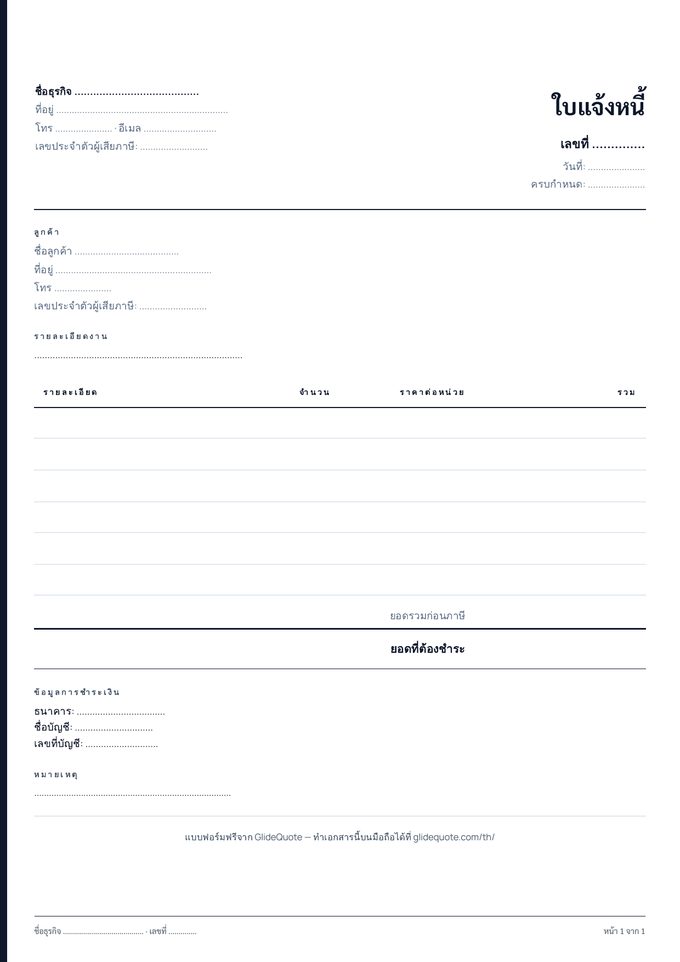 Invoice form (free PDF)A4, Thai, same design as the appAbout the invoice in Thailand →Example, what it must contain, how the app makes it
Do I need a Thai company to invoice in Thailand?
What is the 51/49 rule?
Where do the ฿2 million and the four Thai employees come from?
Do I need a tax ID before my first invoice?
When does VAT start?
Ready to try it?Free plan, no card · Pro is free for the first month