The line
The Revenue Department's English VAT page: any person or entity who regularly supplies goods or provides services in Thailand with an annual turnover exceeding ฿1.8 million is subject to VAT. Section 81/1 of the Revenue Code is the legal hook: a business whose tax base does not exceed the small-business value set by Royal Decree is exempt from VAT, and the Code says that value may not be set below ฿600,000 a year. The ฿1.8 million figure is the one the Revenue Department publishes today.
The 30 days
Registration is on Form VAT 01, before the business starts operating or within 30 days after its income reaches the threshold, according to the English VAT page. Section 85/1(1) of the Code puts the same 30 days in the law: counted from the day the business's tax base exceeds the small-business value. The Revenue Department's English index lists infographics titled “VAT Registration for Business with a Premise in Bangkok”, “… outside Bangkok” and “VAT Registration for Online”.
Registering below the line
Section 81/3 gives a business that is exempt as a small business the right to notify the Director-General and apply for VAT registration. The same section says a business that registered this way can cease paying VAT if it exercises its right to cancel the registration under section 85/10(3) and the Director-General cancels the registration.
What registration brings
The VAT period is a calendar month. The return, Form VAT 30, is filed every month with any tax due, within 15 days of the following month, according to the English VAT page. The rate is 7%. Worked example: a registered plumber invoices ฿10,000 for a job; the tax invoice shows ฿10,000, VAT ฿700, total ฿10,700, and the ฿700 goes on that month's VAT 30.
What changes on your documents
Only a VAT registrant may issue a tax invoice (ใบกำกับภาษี). Section 86/13 says a person who is not a registrant must not issue a tax invoice, debit note or credit note, and a person who issues one without the right is liable for the VAT shown on it as if they were a registrant. Section 86/4 lists what a tax invoice must carry — the words "tax invoice" displayed prominently, the issuer's name, address and tax ID, the customer's name and address, a serial number, the description, quantity and value, the VAT shown separately, the date of issue, and any other particulars the Director-General prescribes — in Thai and in baht unless the Director-General approves otherwise. Section 86/13 reserves the tax invoice to registrants. Which document to issue →
What GlideQuote does
GlideQuote makes the quotation, invoice and receipt on your phone, with your tax ID and company name printed exactly as you set them once in Business details. Mark the business VAT-registered and the invoice heading becomes a tax invoice; switch withholding tax on for a document and the PDF shows the amount withheld and the net amount due. On the day you register, the change is one switch in Settings. The free plan has no card and no time limit; Pro is free for the first month.
This page is general information read from official Thai government pages on 10 November 2026. It is not legal, immigration or tax advice, and it does not tell you what you may or may not do. Confirm your own position with a licensed Thai lawyer or accountant.
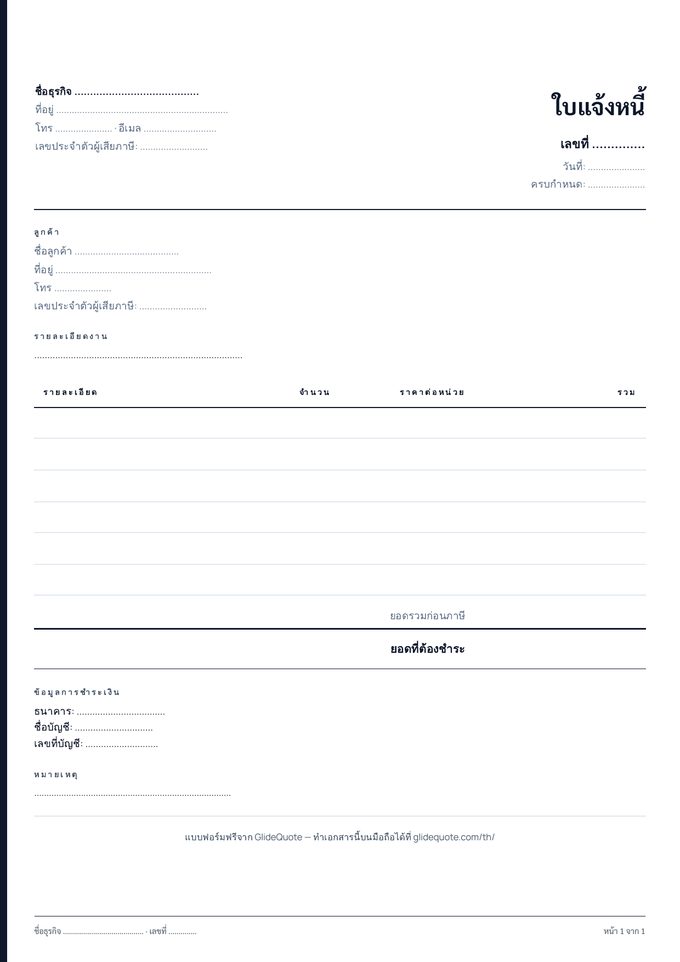 Invoice form (free PDF)A4, Thai, same design as the appAbout the invoice in Thailand →Example, what it must contain, how the app makes it
What is the VAT threshold in Thailand?
How long do I have to register once I pass it?
Can I register before I reach ฿1.8 million?
How often is the VAT return filed?
Can I put “tax invoice” on my invoice before I register?
Ready to try it?Free plan, no card · Pro is free for the first month