The rule
The Board of Investment's March 2025 English note on the working of foreigners — the law is the Foreigners' Working Management Emergency Decree B.E. 2560 (2017), as the Council of State's article on the government portal names it — puts the rule in one line: "No employment without a valid work permit." As quoted, the line says nothing about visas. The same document lists the employer's exposure: employing a foreign national without a valid work permit, or beyond its scope, carries a fine of ฿10,000 to ฿100,000 per foreign national; a repeat carries up to one year's imprisonment, a fine of ฿50,000 to ฿200,000 per foreign national, or both, and a three-year ban on employing foreign nationals.
Who may be granted one
The Foreign Workers Administration Office's page on the government portal lists four categories. The first listed is a foreigner permitted to enter temporarily on a non-immigrant visa who applies under section 7. The others are investment-promotion cases (section 10, BOI and similar laws), the special section-12 cases, and permanent permits. The Ministry of Foreign Affairs' process sheet gives the order: Non-Immigrant B visa from a Thai embassy, work permit from the Department of Employment, a 90-day initial stay on arrival, then extension of stay at the Immigration Bureau for up to a year at a time.
What the application needs
The BOI's One Start One Stop centre publishes the list: Form WP.1, photographs, an employment certification on the prescribed form, an organisation chart showing Thai and foreign staff, your passport, the employer's certificate of incorporation and shareholder list (บอจ.5), and its VAT registration (ภ.พ.01). Every item after the passport is an employer document — the published application is built around a company that employs you.
The ฿2 million and the four Thai employees
These two numbers come from the Immigration Office's published conditions for a foreigner applying to stay in Thailand for business: the business must have paid-up capital of at least ฿2 million, audited financial statements, and a ratio of one foreign employee to four permanent Thai employees. Representative, regional and branch offices are exempt from some of the items. They are conditions for the extension of stay that goes with the work permit, which is why they are quoted as if they were the permit rule itself.
Set-up 1: a Thai-majority company that employs you
Thai nationals hold 51% or more (the DBD definition quoted by the BOI). The company is the taxpayer: it registers, holds its own 13-digit tax ID, sponsors your work permit with the employer documents above, meets the capital and Thai-employee conditions for your extension, and issues the invoices in its own name. You are its employee or director. What goes on the invoice: the company's name, registered address and TIN — never yours.
Set-up 2: a foreign-majority company
Foreigners hold more than 49%. The DBD's note via the BOI: the activity must be checked against the Foreign Business Act lists — List 1 is closed to foreign companies, Lists 2 and 3 need a Foreign Business License. Otherwise the mechanics are the same as set-up 1: the company is the employer and the invoicing party, and the work permit and extension conditions still apply to you as its foreign employee.
Set-up 3: an individual
The Revenue Department issues a tax ID to a foreigner as an individual, and its personal-income-tax page lists 3% withholding on service fees paid to an individual — so an individual invoice and a withholding certificate under that TIN are both things the pages describe. The published work-permit application, however, is built around an employer, and the government pages read for this guide do not describe a permit for an individual with no employer. That is the gap every forum argues about. This page does not fill it: if you intend to invoice as an individual, the question to put to a licensed Thai lawyer is which permit, if any, covers the specific work.
Worked example
A British electrician is employed by a Thai-majority company in Chiang Mai. The company has ฿2 million paid-up capital and four Thai staff; it sponsors his Non-B and work permit. He quotes a hotel ฿85,000 for a rewiring job. The quotation, invoice and receipt carry the company's name, address and TIN. The company is VAT-registered, so the invoice is a tax invoice: ฿85,000 + 7% VAT ฿5,950 = ฿90,950. The hotel, a company paying another company for services, withholds 3% of ฿85,000 = ฿2,550 under Director-General Notice ท.ป.4/2528 and pays ฿88,400, with a certificate in the company's name. His own name appears nowhere on the documents.
What GlideQuote does
GlideQuote makes the quotation, invoice and receipt on your phone, in English or Thai, with your tax ID and company name printed exactly as you set them once in Business details. Mark the business VAT-registered and the invoice heading becomes a tax invoice; switch withholding tax on for a document and the PDF shows the amount withheld and the net amount due. PromptPay QR and Buddhist-calendar dates are available for Thailand. The free plan has no card and no time limit; Pro is free for the first month.
This page is general information read from official Thai government pages on 7 November 2026. It is not legal, immigration or tax advice, and it does not tell you what you may or may not do. Confirm your own position with a licensed Thai lawyer or accountant.
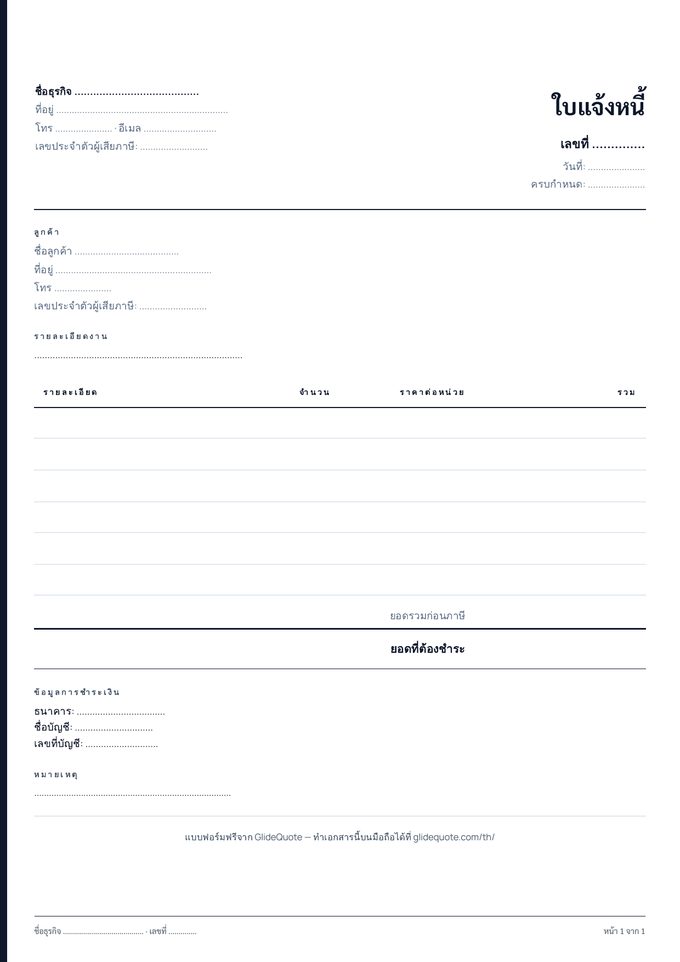 Invoice form (free PDF)A4, Thai, same design as the appAbout the invoice in Thailand →Example, what it must contain, how the app makes it
Can I work in Thailand on a tourist visa?
What are the work permit requirements for the company?
How much does a work permit cost?
What is the penalty for an employer?
Whose tax ID goes on the invoice if a company employs me?
Ready to try it?Free plan, no card · Pro is free for the first month