Who must apply
Section 3 Undecim of the Revenue Code provides that a taxpayer or a payer of income shall obtain and use a taxpayer identification number, issued by the Revenue Department. An individual who has a Thai personal identification number uses that instead. The Revenue Department's English page then lists who must apply: a person liable to personal income tax who does not have a PIN — "i.e. a foreigner" — and any individual who wishes to become a VAT registrant. One exception on the same page: a foreigner present in Thailand for one period of no more than 14 days and no more than 90 days in total in a tax year does not need to apply.
When, and on which form
Within 60 days from the date you first derive assessable income, on Form L.P.10.1 (individuals). A company applies within 60 days of incorporation on Form L.P.10.3 — a Thai juristic person may do that online at tinreg.rd.go.th, in Thai only. A payer of income who has to withhold tax applies on Form L.P.10.4 within 60 days before the income payment date.
Where
In Bangkok, at the area revenue office or area revenue branch office for the area where you are domiciled; in other provinces, at the area revenue branch office. The page adds that an individual may file at any area revenue office, regardless of domicile.
What to bring
For Form L.P.10.1 the page lists photocopies of your alien certificate or passport and the house registration book (ทะเบียนบ้าน) of the taxpayer. The company list (L.P.10.3) is on the same Revenue Department page.
The format: 13 digits
The Revenue Department's English page still says a TIN "comprises 10 digits" and was last updated in 2014. Its own TIN-validation service, updated in 2025, checks a taxpayer identification number of 13 digits — the same service validates the personal identification number on a Thai ID card. That 13-digit number is what goes on your invoices, and what the Revenue Department's tax-invoice rules mean by "tax identification number of the issuer".
Individual versus company
An individual's TIN is personal: it follows you, it appears on invoices you issue in your own name, and withholding certificates from company customers are issued under it. A company has its own TIN (Form L.P.10.3): it appears on invoices the company issues, and the company — not you — is the taxpayer. Do not mix them on one document: the seller named at the top and the TIN beside it must be the same person.
Why it comes before the first invoice
Three reasons from the pages above. The 60-day clock runs from the date you first derive assessable income, which in practice is close to the first invoice. A company customer withholds 3% and remits it under the payee's TIN — with no TIN there is nothing for the certificate to be issued against. And if you register for VAT, the tax invoice must carry the issuer's TIN by law. Worked example: you invoice ฿30,000 for a design job; the company remits ฿900 under your 13-digit TIN and pays you ฿29,100; at filing the ฿900 is credited to you because it was recorded against your number.
What GlideQuote does
GlideQuote makes the quotation, invoice and receipt on your phone, in English or Thai, with your tax ID and company name printed exactly as you set them once in Business details. Mark the business VAT-registered and the invoice heading becomes a tax invoice; switch withholding tax on for a document and the PDF shows the amount withheld and the net amount due. PromptPay QR and Buddhist-calendar dates are available for Thailand. The free plan has no card and no time limit; Pro is free for the first month.
This page is general information read from official Thai government pages on 7 November 2026. It is not legal, immigration or tax advice, and it does not tell you what you may or may not do. Confirm your own position with a licensed Thai lawyer or accountant.
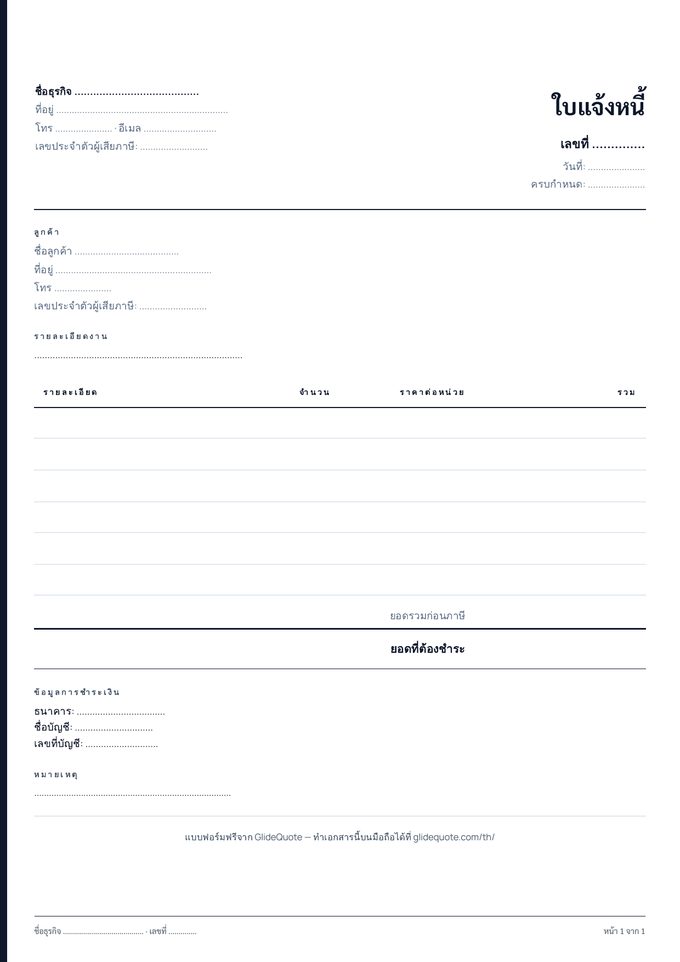 Invoice form (free PDF)A4, Thai, same design as the appAbout the invoice in Thailand →Example, what it must contain, how the app makes it
How many digits is a Thai tax ID?
How long do I have to apply?
Can I apply at any revenue office?
Does my company need a separate TIN from me?
Is a tax ID the same as VAT registration?
Ready to try it?Free plan, no card · Pro is free for the first month